Kendra Rae Phillips
The Other Black GirlKendra Rae Phillips is an editor, advocate for Black writers, and long-missing figure whose history links the triumph of Burning Heart to the book’s troubling aftermath. Her work with Diana Gordon helped produce a novel that found a vast readership despite the limited support Richard Wagner had given it. Later, Kendra’s disappearance, her suspicions about Richard, and her interventions on behalf of people caught in the OBG conspiracy make her both a witness to the system and an architect of resistance against it.
Identity and Literary Formation
Kendra’s documented history is closely bound to books and to the question of who has authority to represent Black life. The evidence does not supply a detailed account of her childhood, but her career places her inside a publishing world in which Black writers and editors were unusual enough to make their collaboration itself consequential. The gap between that professional expertise and the industry around her becomes especially visible through her work with Diana Gordon.
Diana’s first book had already made a deep impression on Nella Rogers, who received it from her parents for her fourteenth birthday, read it three times in one August, and later made it central to a senior thesis. Nella understood the novel’s creation by Black women as part of its social significance, and came to regard such authorship and editing as rare. Kendra’s connection to the book was not incidental: she was the editor whose work helped shape it, and she would later describe the circumstances of its publication as a series of decisions made in anticipation of failure.
That early readership gives Kendra’s later career a distinctive frame. Her work is measured not only by the commercial outcome of a book, but also by the forms of recognition, editorial attention, and institutional investment afforded to Black women. Her experience allows her to identify how a publisher can appear to welcome a book while limiting the resources available to it.
The Success of Burning Heart
When Burning Heart appeared, Kendra and Diana were initially two little-known Black women whose achievement exceeded expectations. Within its first week, the book had generated enough attention to make the country buzz; interviews filled the next three months, and a major weekly magazine was considering the pair for its cover. The sudden visibility contrasted sharply with the modest publicity support they had received before publication.
Kendra interpreted that disparity as evidence of Richard Wagner’s calculation. She pointed to his decision to let her edit Diana’s book rather than edit it himself, the small budget, and an author tour that lasted only two weeks. In her view, those choices had been arranged to limit the publisher’s exposure if the novel failed. The book’s success therefore carried a double meaning: it brought Kendra and Diana public recognition, but also made visible how little faith the publisher had initially placed in their work.
The success intensified Kendra’s professional and personal connection to Diana. The evidence presents the two women together amid interviews and the possibility of a magazine cover, and Kendra’s account emphasizes that she had fought Richard at each stage of the process. Their achievement was collective, but Kendra’s description insists on the labor hidden behind its public celebration: the editorial advocacy and resistance to institutional caution that had helped the book reach readers.
Disappearance and the Return of the Record
Years later, Nella describes Kendra as missing in action for years. Her absence is not merely a gap in the publishing story: it becomes an unresolved question that shapes Nella’s understanding of the people and events surrounding Burning Heart. Nella is herself intensely interested in Kendra and the novel, and the eventual appearance of Kendra’s image in a file turns that interest into immediate alarm.
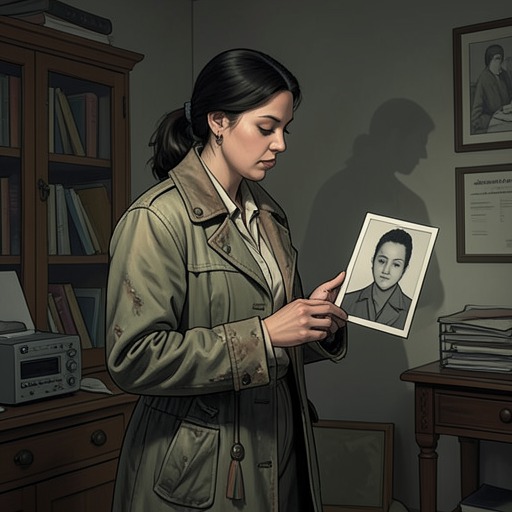
The file contains a photograph of Kendra that Nella recognizes unmistakably. Nella photographs it, along with a picture of herself elsewhere in the folder, and reads the accompanying notes. The image appears to date from around the publication of Burning Heart and may be one of Kendra’s last public photographs. Beside it, Richard’s handwritten records range across decades: they include a possible sighting upstate in 1986, a note from 1992 wondering whether Kendra had moved to Paris, and a later entry recording a confirmed sighting near the intersection of 100th Street and Broadway on October 20, 2018. That entry says that Kendra took Shani Edmonds’s phone and then went underground.
The file changes the meaning of Kendra’s absence. Rather than a clean break from public life, the record suggests that Richard continued to track possible sightings over many years. Nella’s response is divided: she wants to read every word, yet also feels an impulse to destroy the file. Kendra is thus recovered through the same kind of documentation that threatens her—an image and a trail of handwritten observations that reveal both her survival and the extent of the surveillance surrounding her.
Suspicions About Richard and Diana
Kendra’s account connects her disappearance and damaged relationships to what she believes Richard did to Diana. She tells Shani that the change she has seen in other Black women may have happened to Diana as well, and identifies Richard as the person she suspects. Kendra offers this as the only explanation she can make of Diana’s conduct toward her, including Diana’s refusal to be seen with her publicly after Kendra had spoken out. The evidence establishes Kendra’s belief, not independent confirmation of every part of her theory; its force lies in the way she links a personal rupture to a wider pattern of transformation and control.
The surviving press material also records Kendra’s opposition to the routine dependence on white writers to interpret Black history and culture. In an article clipping shown to Nella, Kendra objects to white writers being treated as necessary authorities on subjects such as the Great Migration and Black cultural traditions. The position complements her experience as an editor: representation is not only a matter of which stories are published, but of who is presumed qualified to explain them.
Kendra’s critique also gives her conflict with Diana a painful complication. The public partnership that helped make Burning Heart a success did not guarantee lasting solidarity. Kendra believes Diana was changed and that this change explains her withdrawal, but she also recognizes that the transformation has already reached deeply into their shared world. Her account of the fracture remains an interpretation formed by someone with intimate knowledge of Diana, rather than a neutral explanation supplied by the institution that watched them.
Resistance, Release, and Strategy
Kendra’s later actions show that she remains capable of intervening even while trying to keep her distance. Nella’s recollections associate her with an urgent appeal for help and with a return to contact after a period in which she had avoided former colleagues and most remaining friends. At one point, after focusing again on a Jacob Lawrence print, she calls Lynn Johnson. These moments suggest a narrow, deliberate network of contact rather than a return to ordinary public life.
Most consequentially, Kendra persuades one of the people holding Nella to let her go. Nella understands that intervention as creating an obligation: Kendra has promised that if they are left alone, they will leave Nella alone, and Nella decides not to send her message immediately because she owes Kendra silence while awaiting further instructions. The exchange binds Kendra’s protection of Nella to a demand for restraint, making trust and secrecy part of the same arrangement.
Kendra’s strategic position is not uncomplicated. In a later conversation, she appears ready to withdraw from Lynn’s mission, arguing that it is already too late to stop Diana and that the Resistance has fallen behind events. Yet she also describes a longer plan: remain quiet, watch the Hazels of the country rise to influential positions, and then cut OBGs off from their supply. The proposed delay is not passivity. It is a choice to observe the system’s expansion before acting against the resource on which it depends.
Kendra’s trajectory therefore resists a simple return-to-normal resolution. She moves from acclaimed editor to absent subject of surveillance, then back into the story as a witness, protector, and strategist. Her history exposes the uneven conditions behind Burning Heart’s success; her suspicions connect private betrayal to the transformation of Black women; and her final strategy treats silence as a temporary tool rather than surrender. Even when she doubts that the Resistance can get ahead of the crisis, she continues to identify ways to act and people who may still be trusted.